
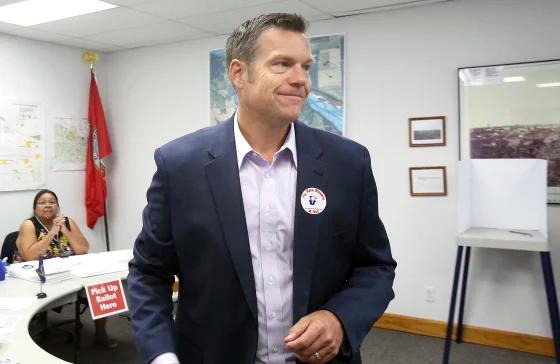
Coldwater voters returned Jose Ceballos to the mayor’s office. The next day, Attorney General Kris Kobach announced six election-related charges against him. A small-town result became a test of whether Kansas election rules still apply after the votes are counted.
The Attorney General’s office says Ceballos faces three counts of voting without being qualified and three counts of election perjury. The charges were filed in Comanche County. Each is a nonperson felony. The release says the allegations could expose him to more than five years in prison if he is convicted.
Kobach did not soften the charge. “In Kansas, it is against the law to vote if you are not a U.S. citizen,” he said. “We allege that Mr. Ceballos did it multiple times.” His point is simple: an election cannot be a private club protected by a weak verification system.
Secretary of State Scott Schwab tied the case to his years-long fight over citizenship checks. “We’re left relying on individuals’ word when it comes to verifying citizenship,” Schwab said, after describing his work with Kobach on proof-of-citizenship proposals. He also credited President Trump’s SAVE program as a tool to help states verify voter information.
The charges reveal a gap between an eligibility rule and the machinery used to enforce it. Kansas law generally requires city candidates to be qualified electors and residents, but cities have home-rule authority. The Attorney General’s release says the city attorney will determine whether Ceballos may remain mayor while the criminal case proceeds.
That arrangement puts responsibility where it belongs. Investigators must build the case, prosecutors must prove it, and local officials must address the officeholding question under Kansas law. Kobach’s office identified KBI Special Agent Nate Humble, Special Agent in Charge Matt Simpson, and First Assistant Attorney General Stacy Edwards in those roles.
The case carries a warning for officials who treat election integrity as a speech rather than a duty. Schwab said every noncitizen vote “effectively cancels out a U.S. citizen’s vote.” That is why a charge filed in a town most Americans could not find on a map matters statewide: small elections still decide who holds public power.
Kobach’s office described noncitizen voting as a real problem, not a theoretical one. The investigation is a reminder that a ballot is not a courtesy extended by a local officeholder; it is a legal act with consequences for every citizen whose vote helped choose the government.
Ceballos is presumed innocent unless proven guilty in court. The filing is an allegation, not a conviction. The legal process must decide the facts, not a press release.
The political message is clear. Kobach and Schwab are refusing to let the words “small town” become an excuse for looking away. Kansas voters deserve an election system that can identify violations, investigate them, and put the rule of law ahead of the officeholder’s title.