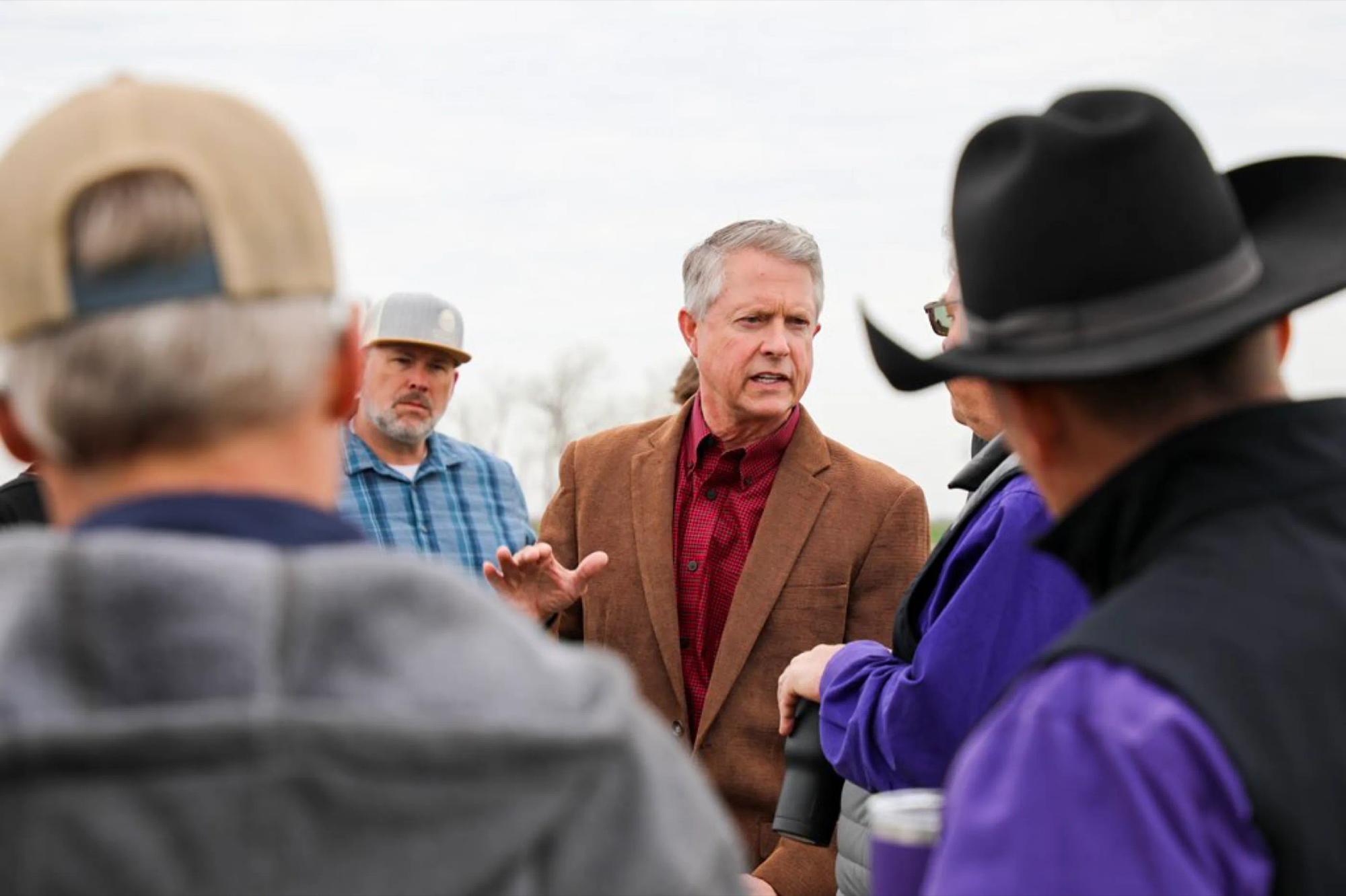
At a Kansas feedlot, every feed decision lands on the producer’s margin. The state’s latest inventory includes about 5.95 million cattle and calves and 2.01 million hogs. Sen. Roger Marshall is taking on the federal review process that keeps better animal-health, food-safety and environmental tools crawling toward producers who need them now. He joined Sen. Jerry Moran and a bipartisan group to reintroduce the Innovative Feed Enhancement and Economic Development Act, known as the Innovative FEED Act.
The measure would create a new category in the Food and Drug Administration’s animal-food additive petition process for ingredients intended to address animal health, food safety, or environmental benefits through an animal’s diet. Marshall’s target is not the idea of safety review; it is a system that can turn a promising American product into a paperwork hostage.
Marshall’s words are blunt: “outdated regulations are holding back our feed industry”. He also warns that innovations are being pushed overseas instead of developed in America. Kansas cattlemen should not lose the next useful technology because Washington cannot build a clear lane for reviewing it.
The FDA’s animal-food rules require added substances generally to be covered by a food-additive regulation or meet the generally recognized as safe standard for their intended use. FDA uses food-additive petitions, GRAS notices, and other premarket processes. FEED would add a statutory category for qualifying products; it would not approve a specific additive or erase safety evidence.
Marshall is not asking FDA to throw open the gates. He is asking the agency to separate a rigorous review from an endless maze. A clear process can demand data, protect animals and consumers, and still let American livestock producers compete.
The coalition reaches across the usual Washington fault line. Marshall and Moran introduced the proposal with Wisconsin Democrat Tammy Baldwin and Colorado Democrat Michael Bennet. The announcement lists the American Feed Industry Association, National Milk Producers Federation, National Council of Farmer Cooperatives, and Environmental Defense Fund among its supporters.
The Environmental Defense Fund is among the supporters, and the proposal reaches beyond production speed. It includes ingredients aimed at environmental benefits, giving conservation advocates a reason to demand innovation rather than defend the status quo. The argument is direct: test the tools, enforce the rules, and stop letting delay decide which ideas survive.
The FEED Act has been reintroduced and awaits congressional action. FDA would still review any qualifying product under the new pathway, and the Kansas agriculture overview shows how much livestock country has at stake.
Marshall is giving Kansas producers a choice Washington has withheld for too long: compete with the next generation of feed technology here, under real safety standards, instead of watching it leave for another country. The feed bunk does not wait. Neither should federal policy.