
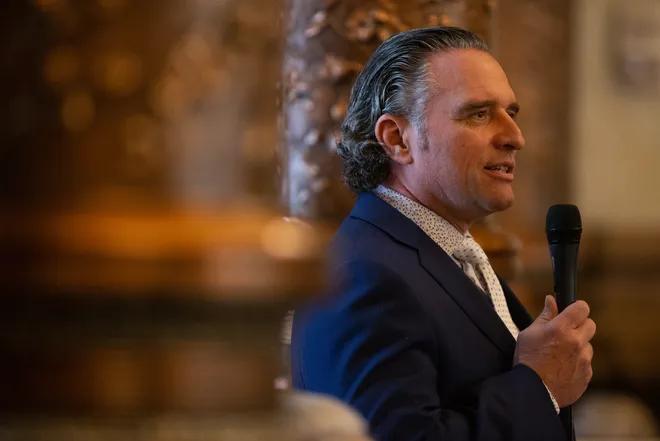
On Sept. 13, 2024, a microphone at Kansas State University was turned off while Charlie Kirk was answering questions. The Kansas Legislature’s conference report says Kirk continued by walking into the crowd. That incident became the kind of campus memory politicians usually file away and forget. Ty Masterson and Kansas Republicans did the opposite.
They named the Kansas Intellectual Rights and Knowledge Act, the KIRK Act, and put Senate President Ty Masterson behind a direct challenge to the campus bureaucracy that controls access to public forums. After Gov. Laura Kelly vetoed the measure, the Legislature overrode her on April 9, 2026.
The bill summary applies to public universities, community colleges, technical colleges, and other public postsecondary institutions. Outdoor campus areas are public forums. Lawful, noncommercial expression must be allowed unless it materially and substantially disrupts operations.
The law also bans “free speech zones”, designated pockets outside which expression is forbidden. Institutions may impose time, place, and manner rules, but those rules must be clear, published in advance, content- and viewpoint-neutral, narrowly tailored, and paired with reasonable alternatives. That rebukes a system that can bury a dissenting voice in paperwork while calling the result neutrality.
Masterson’s allies treated the issue as concrete. The conference report declares that public campuses should be “bastions of intellectual diversity, open debate and the free exchange of ideas, regardless of political or ideological affiliation.” The KIRK Act puts that promise into statute: a campus funded by Kansas taxpayers cannot make lawful speech depend on an administrator’s comfort.
Security fees face rules too. An institution cannot charge based on the content of an event, although it may consider neutral factors such as location, expected audience size, or alcohol. Annual reports must identify barriers, incidents, and discipline, and those reports become public.
That reporting requirement matters. A campus office can no longer bury a controversial invitation in a policy manual and call the silence administrative routine. If officials block lawful expression, the public can see the incident, the institution must account for it, and the person shut out has a route to court.
The reform also protects spontaneous assembly and literature distribution, subject to clear rules that apply equally. It makes one fact impossible to obscure: a public forum belongs to the public, including when the message is unwelcome.
Enforcement changes the stakes. The attorney general or an individual can sue. Public institutions do not receive immunity. Damages begin at $500 for an initial violation, with $50 for each day a policy or violation continues. A rule that can cost money gets attention faster than a slogan about openness.
The law still permits institutions to restrict expression that materially and substantially disrupts operations. What it blocks is the quiet substitution of viewpoint control for order.
Kansas Republicans looked at the dark microphone, the public money behind the campus and Kelly’s veto, then refused to retreat. Masterson’s majority chose a simple standard: if a lawful voice can be heard, officials do not get to pull the plug because they dislike the message.